 Keilini
Updated October 2026 · Written by the Keilini Heater Pro UK team
Quick answer
Are fan heaters expensive to run? They use electricity at their rated wattage while heating. Because they warm you up fast and can be switched off sooner, they're often cheaper in practice for short sessions than heating the whole house.
How a fan heater works
A small fan draws cool air in, pushes it across a heating element and blows warm air into the room. Because it moves air actively, you feel the heat within seconds rather than waiting for a radiator to warm up.
Ceramic vs wire-element fan heaters
Older fan heaters use bare coiled wire that glows red-hot. Ceramic PTC fan heaters use ceramic plates whose resistance rises as they heat, so they naturally limit their own temperature. That makes them a popular choice for homes with children and pets.
What to look for
- Noise level — under 45dB is quiet enough for bedrooms
- Thermostat so it doesn't run flat out all the time
- Tip-over switch and timer
- Wide airflow angle for even warmth
- Cool-touch casing
What size room suits a fan heater
Fan heaters excel at warming a person or a small-to-medium room quickly, rather than slowly bringing a large space up to an even temperature. For a bedroom, home office or box room, a compact fan heater can take the edge off the cold within minutes. For a large open-plan lounge or a room with high ceilings, you'll likely need to run it longer, position it closer to where you sit, or pair it with another form of heating.
As a guide, think about how the room is used: if you need quick personal warmth for an hour or two, a fan heater is ideal; if you need gentle background heat all day, a fan heater running constantly won't be the most efficient choice.
Real running-cost maths for a fan heater
Fan heaters are resistance heaters, so a 1kW model uses 1kWh of electricity for every hour at full power. At 25p per kWh that's 25p an hour; at 30p per kWh it's 30p an hour — check your own tariff on your bill or Ofgem's price cap page.
Because a thermostat switches the element on and off once the room reaches temperature, the heater isn't always drawing full power, so your actual bill is often lower than a flat 'wattage × hours' sum suggests. Using the timer to limit sessions to when you actually need warmth is the simplest way to control the cost.
Our pick for warming one room
Keilini Heater Pro
Ceramic PTC · warm in ~3s · 36–45dB · tip-over & timer shut-off
£59.98£119.98Save 50%
See packs & prices- Free UK delivery
- 30-day returns
- Secure checkout
Fan heater placement and safety
Fan heaters blow air, so give them a clear path — don't point one directly at curtains, paper or bedding, and keep at least a metre of space around the unit. Stand it on a flat, stable surface so the airflow isn't restricted and it can't be knocked over easily.
Plug it straight into a wall socket rather than an extension lead, particularly if you're running it for more than an hour, and check it has tip-over and overheat protection before leaving it unattended even briefly.
Using a fan heater to cut your heating bill
The main saving comes from heating only the room you're in rather than the whole house. If you work from a home office, or spend evenings in one living room, turning the central heating thermostat down a degree or two and using a fan heater locally can lower your overall gas and electricity use.
Pair this with simple habits: close the door to keep warm air in, use the timer so it doesn't run longer than needed, and switch it off the moment you leave the room.
Who a fan heater suits — and who it doesn't
A fan heater suits anyone who wants fast, portable, personal warmth for an hour or two at a time: home workers, bedrooms, conservatories used occasionally, or anyone who feels the cold quickly. It's less suited to people who want silent background heat running for many hours, since the fan noise (even a quiet one) runs continuously, and to very large or draughty rooms where it struggles to make a noticeable difference on its own.
If silence and long, steady heat matter more to you than speed, an oil-filled radiator may suit you better.
Where Keilini Heater Pro fits
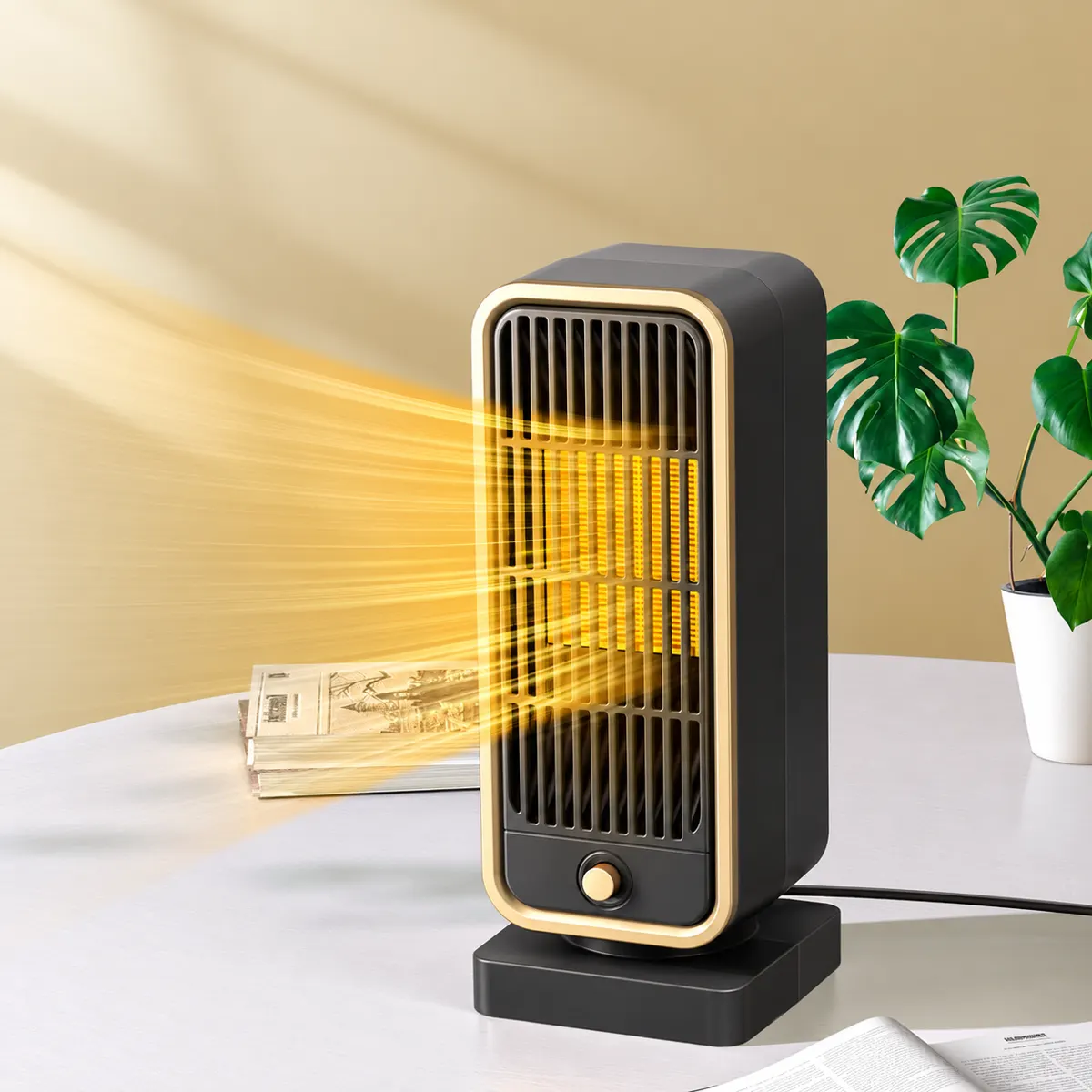
Keilini Heater Pro is a compact ceramic PTC fan heater. It starts producing warm air in around 3 seconds, spreads it through a 90° grille, and runs at roughly 36–45dB. A built-in thermostat holds your chosen temperature, a tip-over switch cuts power if it is knocked over, and a timer switches it off after 1–12 hours.
It is designed to warm the room you are in — not to replace central heating for a whole house.
Typical fan heater vs Keilini Heater Pro
| Feature | Budget fan heater | Keilini Heater Pro |
|---|---|---|
| Element | Bare wire | Ceramic PTC |
| Noise | Often 50dB+ | Approx. 36–45dB |
| Timer | Rare | 1–12 hours |
| Tip-over off | Sometimes | Yes |
| Airflow | Narrow | 90° wide |
Buying checklist
- Noise rating — look for under 45dB if it's for a bedroom or desk
- Ceramic PTC element rather than a bare wire element
- Thermostat to avoid constant full-power running
- Tip-over switch and overheat protection
- Timer for automatic switch-off
- Wide airflow angle (such as 90°) for more even coverage
- Cool-touch outer casing
- UKCA or CE marking and a UK plug
- Clear manual stating wattage and safe clearance distances
Mistakes to avoid
- Pointing the airflow directly at curtains, bedding or paper
- Using it as the sole heat source for a large, cold room
- Running it continuously instead of letting the thermostat cycle
- Standing it on thick carpet where it can tip or restrict airflow
- Leaving it running when you leave the room
- Using a cheap extension lead for a long session
Our pick for warming one room
Keilini Heater Pro
Ceramic PTC · warm in ~3s · 36–45dB · tip-over & timer shut-off
£59.98£119.98Save 50%
Or 3 for £139.97 — £46.66 each.
See packs & prices- Free UK delivery
- 30-day returns
- Secure checkout
Frequently asked questions
Are fan heaters expensive to run?
They use electricity at their rated wattage while heating. Because they warm you up fast and can be switched off sooner, they're often cheaper in practice for short sessions than heating the whole house.
Are fan heaters noisy?
Some are. Keilini Heater Pro runs at roughly 36–45dB, similar to a quiet library.
Is a ceramic fan heater better?
Ceramic elements self-limit their temperature and heat up quickly, which is why many people prefer them over bare wire elements.
Can I leave a fan heater on overnight in a bedroom?
Only with tip-over and overheat protection, kept well away from bedding, and ideally on a timer so it switches off automatically rather than running all night.
How much does a fan heater cost to run per hour in the UK?
A 1kW fan heater uses 1kWh per hour, so at 25p per kWh that's 25p an hour. Multiply your heater's kW rating by your own electricity rate from your bill or Ofgem's price cap page.
Is a fan heater cheaper than central heating?
For warming one room for a short time, often yes, since you're not heating the whole house. For heating your whole home for hours, gas central heating is usually cheaper per unit of heat.
Why are fan heaters noisy?
The fan motor and moving air create the noise. Ceramic fan heaters with better-balanced fans, such as those rated around 36–45dB, are generally quieter than older budget models.
Do fan heaters dry out the air in a room?
Any heater can make a room feel drier because warm air holds less relative humidity. If this bothers you, a bowl of water nearby or a humidifier can help.